Friday, April 29, 2011
The Queen is a Golfer
Thursday, April 14, 2011
INSIDER INFORMATION
Don't be concerned with the sod you can see, we are finishing up the repairs to the collar after excavating out all the heavy clay last fall. All the sod will be complete and in place before the end of today. And this, the 7th green also taken photo taken at 1:30pm.
And below, the 10th green. Although this picture is not from today. It was taken on Wednesday. Ya, I know, the lines look a little squiggly, but that's just because we are training new staff to mow greens.
I don't have time to post pictures of all 18 greens, but all I can say is.............more of the same conditions on all of them! Now the rough is not quite starting to grow yet, so it still looks a little brown, but the rest of the property............WOW! If the rain they are calling for on Saturday is a warm rain out of the Gulf of Mexico, the grass is going to explode out of the ground. So here it is, if you have been waiting to play a round or two before setting up any golf with guests..................DON'T......... Call your guests and invite them out NOW! With the opening date pushed back to the 20th, you only have 11 golfing days in April. TRUST ME!! Don't wait to see it for yourself! Book your tee time now and WOW your guests with your course conditions this spring. And if there is a chance you have a friend who was thinking about joining, but thought they should wait until the end of May or early June for the course to come around.......phone them NOW................and tell them to call Alex before word gets out and prices jump - because the will! DON'T SAY I DIDN'T TELL YOU!
Friday, April 8, 2011
A SIDELINE 30 EXCLUSIVE!
Arrived thinking what a great job this is going to be hanging around outdoors, getting fresh air, and working on my tan. Superintendent Blair Rennie welcomed the new hires, congratulated us on being selected to join the team and told us that the six of us were selected out of over 100 applicants. (Really? Over 100? Kind of hard to believe, but then he shows us the pile of resumes. Wow, feeling kind of special.) Then he informs us there are high expectations for all of us. We will be expected to work safely, while attaining adequate productivity with the highest quality in everything we do. What? So now I’m expected to actually work? At this point we were matched up with an experienced team member and sent out to different assignments. On the way onto the course I’m shocked at what I see. I thought this was a private club with high quality. Everywhere I look there are branches down, sand and gravel all over the driveway, as well as the parking lots and paths. Leaves and pine cones are scattered everywhere. I spent the rest of the day picking debris out of bunkers. Pine cones, stones, leaves, sticks, garbage. At one point we were sent back to a bunker that had a few small stones we missed. “NOT GOOD ENOUGH” barks Rennie; it all has to be removed! After about an hour and a half, I suggest to the person I’m working with, “let’s go get a coffee”. He looks at me for a brief moment and starts laughing. “Coffee?” he chuckles, “You ain’t worked long or hard enuff to deserve a break” While working and moving from trap to trap I was able to get these photos.
One of the greens tarps was just removed moments ago.
Day 2 through 5
I pass by a big loud machine grinding stumps into saw dust. A small crew follows behind, picking up the spilled debris and adding soil into the hole. At other times I can hear the buzz of a chainsaw. Another man is repairing a broken fence post. Range mats are being pressure washed, and another is painting some wood slats. (Which I find out later are something called “hazard stakes”) Talking to Kyle at lunch I’m shocked to find out that this crew has about 130 acres of golf course, parking areas, driveways, driving range and so on to clean up and prep for opening day. Think I’m starting to have a little more appreciation to the task at hand.
Date, unknown, sometime in the second week.
One day just flows into the next, with seemingly no off time between days. My back hurts, I have blisters on hands and feet which are constantly throbbing. My feet are wet, and I have sand in my mouth and eyes. I hear rumours the opening date is now official. Wednesday April 20th. Unless “Large Marge” says differently mumbles Rennie. Who the heck is Large Marge I ask one of the other rookies? He shrugs his shoulders and gives a little whimper of pain, “Maybe its Rennie’s wife.” We arrive back to the lunch room at the end of the day and on the large white board that dons the wall, we find “T minus 8 days” written on it. “Is there a space shuttle launch?” is all my brain can think, later realizing that meant 8 days left before opening day. Starting to wonder how all this work is going to get completed. Other things I’m witnessing, tarps that were neatly folded up beside some of the greens are being brought in. Water coolers are being scrubbed with soap and water. Delivery trucks are in and out all day, although I have no idea what they may be dropping off. Ball washers are being dismantled, cleaned, some parts are being replaced and rebuilt.
Later on in week #2
Can’t get onto the course because of frost. Awesome, I’m a little tired, can handle playing some euchre, drinking some coffee with the crew. As I make my way to the coffee station I hear Mickey (Mickey has been at Whitevale as long as anyone I assume) “Hugh, lets go”. Lets go? I was planning on putting my feet up and having a coffer. Before I know it I’m out in the cold morning air, cleaning up sand and gravel on the paved roads, parking lots and cart paths. Well at least I’m not back in one of those bloody bunkers. The next morning the frost stopped us once again from getting on the course. So Kyle said there would be training for all staff on WHMIS. Well I know what that is, it stands for Workplace Hazardous Material Information System. I did my WHMIS training only 3 months ago. So I approached Kyle to tell him I didn’t need this training. Sorry he says. Just because you were trained by another employer does not mean it counts here. By law we must train all staff, and redo the training each year for all returning employees. Ahhhh really – that seems like a silly law.
Later, after the frost is up and we are done the training, I see the irrigation system running. Now its clear to me Rennie has no clue what he’s doing. We had rain only two days ago, he tells us every morning how much damage can be done if we don’t drive on paths because it’s so wet, and now he’s running irrigation on an already saturated golf course! How did this guy get this job?
The next morning as I go by the same area and as if magic the pipe is all repaired, I never saw anyone there, yet it’s all back together.
Tuesday, March 22, 2011
GREENS - UP DATE ON COURSE CONDITIONS, MARCH 22ND
So...............out came the shovels!
(Between writing the Sideline article and yesterday we have received almost 15 cm snow and 4 inches of rain. Temperature have been as low as -14C and as high as 8C)


A shop Vac has proven the most productive, and least damaging way to remove water from our greens. Not every green, or the entire surface of any green needs this much attention. Only the low areas and greens with high Poa are at extreme risk of damage.

Water is dumped anywhere it will flow away from the green.
In all we have shoveled and vacuumed parts (or in a couple cases all) of 13 greens over the last 3 weeks. All this back breaking work has paid off as we are currently in great shape!

These tire marks look worse than they are. The ground was frozen at the time and this visible damage is to the leaf of the plant. So once we get some temperatures where the plants begin to grow, this damage will be mowed off and not cause us any issues.
Below is the 8th green, photo taken March 21st. The vast majority of greens do look this good. The tarp was removed from here and installed on the 1st green to help raise soil temperatures and give the turf a jump start.
Monday, January 31, 2011
GREENS, SO......WHAT DO WE DO IN THE WINTER?
Well, not exactly. It is true winter is usually our time to rest, re-acquaint with our families and take a vacation. In a perfect winter I would come to work and have no stress or worries.
This picture below would be worth a million bucks if I could count on this weather every day from December 1st to March 21st.
This is exactly what the turf, and the Superintendent need. Cold crisp days, with a covering of snow on everything. But every year is a little different.
I am happy to report that as of today everything is pretty much perfect. All pre-winter programs to strengthen and protect the turf for the long winter went perfectly. We currently have no ice build up anywhere, and about 10 or 15 cm of snow covers the turf which acts like a blanket to protect it from the cold winds.
This, as you know is a far cry from last year when at this time we had already been under a layer of ice for 6 weeks. This picture below, taken last January tells a real story. You may recognise this as the 11th green and approach.

Notice the solid ice layer on the approach? If you get ice build up on an area with a slope like we have on 11 approach, you can guess how bad an ice layer we had on the flat areas!
So last year we spent many hours breaking up the ice and removing it from our putting surfaces with our aerifier.
But not every winter is so harsh to us! If you have been watching the news you have seen "LARGE MARGE" is causing all kinds of big problems in Australia with flooding. Our friends on the south east coast are having more snow than ever recorded.
There will be courses with ice damage this spring, but they all seem to be through Ohio and Pennsylvania and possibly east through New England. Unfortunately it's just their turn this year.
In other years we have used the winter to move trees with a tree spade. We use our tractor mounted snow blower to clear haul roads for the truck to move around the course Then we wait for the frost to get deep in the ground, allowing the truck no problem moving around the course without causing any damage.

But beyond these special projects, we have some obvious, and maybe not so obvious, responsibilities.
There are 3 of us who work 12 months of the year in the Turf Department. Kyle, our Assistant Superintendent, Scott, our Equipment Manager and me. Many of the private clubs around us which we have reciprocals with keep 5 and 6 people on all winter.
With an equipment replacement value of 1.2 million dollars you can guess Scott is almost busier during the winter than the summer. He brings all equipment into his work bay, one piece at a time and goes over every part. We have a very good preventative repair program in place.
Scott inspects and replaces any parts starting to wear, rather than waiting until they have failed completely and have to be replaced. This is very time consuming, but imperative to a successful turf operation all season. Without doing Preventative Maintenance, when a part fails, it usually caused other parts attached to it or near it to fail as well. Now we would have a machine broken down, during the season when we need it. This would also mean a longer time frame to repair it and it would tie Scott up from all other equipment. Bushings, bearings, hydraulic hoses, electrical wiring, tires, engines burning oil, all are repaired, even sharpening of all mowers are completed.
If you are concerned we are wasting money by replacing parts that may still have 3 or 4 months of life left in them, I am happy to report we are saving money! Even with all the additional equipment we have added to the fleet over the last 7 years, I am actually spending $10,000 less a year on equipment repairs then the club was spending the year I arrived! (This may be the only line item that hasn't gone up).
Some of the equipment is too large to fit in the Mechanics Bay, so Scott has to carefully plan to maintain the larger equipment in the fall and late spring when the weather is conducive to working outdoors.
Kyle and I are kept busy with a multitude of items. We are responsible for keeping the drive way and parking lots clear of snow and ice. We make sure security can access doors to every building. If the weather is good, we can get outside to prune trees and shrubs. Some trees are taken down, cut up and removed completely. These would include trees which pose a danger and trees which were planted too close and need to be thinned out for the health of the trees around it.
Inside we have a lot of planning and review we go through. We look at all "course furniture" such as tee blocks, flag sticks, ball washers, benches, water coolers, hazard stakes, bunker rakes, fertilizer spreaders.........................well, the list goes on. All these items will need a plan to make them ready for opening day. Do they need sanding and a coat of weather seal? Do they need repainting? Do we need to order parts and do repairs? Maybe we want to replace something on the course with a newer, better version.
Like this chit box by the 10th tee.................
Do you remember what it used to look like?
The design of the new box was worked on a couple of winters ago, and built in March.
Not only do we decide what needs to be done, but must determine what we need in parts and need to get the order in so work can begin. Some items are physically worked on in the winter, others are made ready to be worked on when our first employees start back in the early spring.
We review all maintenance programs completed in the previous year and discuss changes required. This goes for aerification, fertilizer and pesticide applications, mowing schedules, verti-cutting, top dressing, divot filling ETC...
As we review all these things we ask ourselves what can we do to improve the program, to make it more efficient, or end up with better results, or cut costs.
We review all staff and determining what their strengths and weakness are and if we have them performing the right jobs. Maybe they are better suited to a job they have not yet been trained for. We revisit all training each staff member receives.
Did you know each piece of equipment has a four level training regiment for each employee that will use that machine?
Did you know every employee goes through the training every spring even if they have gone through it many time before? Each employee is requires to read the operators manual, then watch a safety/operators video. Then we do a walk through of the controls and circle check. And finally we have written what we call "Site Specific Training". Within this is information about where they should and should not drive. For example some equipment is never allowed to travel up or down the cart path by the 4th or 12th tees for safety reasons. Also within this are things they need to be aware of for the safety of the operator, fellow workers as well as members and their guests. We also have specific items in this document the operator has to know and follow to prevent damaging the turf.
Uniforms, flowers in the gardens, new staff orientations, Health and Safety, all carefully reviewed every winter for additions, improvements and to be sure we are compliant.
Each year I need to have a report compiled and submitted to the Ministry of the Environment in keeping with the requirements of our Permit to Take Water (PTTW). Without this document being successfully complied and submitted on time the course would not be able to take any water from any of the wells on the property which supply water to both the Maintenance and clubhouse or the river for irrigation.
The winter is a very important time for continuing education. Last year I was fortunate enough to be invited to take part in a week long program at the prestigious Richard Ivey School of Business, at the University of Western. This specially designed program for Golf Course Superintendents is by invitation only and I was honoured to be included with some of the top Superintendents from not only Canada, but from parts of Europe as well. While attending I found out they were planing on starting another program aimed at the Assistant Superintendents. I quickly make contact with a number of people I know and was able to get Kyle invited to this program which he is attending this week.
We regularly attend seminars or conferences to stay in touch with the latest research and technologies. If you have ever been in my office you have seen the large pile of trade magazines that I never seem to have time to read, so when there is snow on the ground I try to reduce the stack.
We meet with industry representatives for information on products and pricing. The government has banned many products over the last bunch of years and we need to know what we can replace them with that will do the same job, and not increase costs anymore than necessary. Sales representative are pretty good about introducing us to products which may be usable in place of a banned product, but they don't always inform us about weaknesses these new products may have, so there is always research to be done on all new products.
We start to review resumes and conduct interviews for the new hires to the upcoming season.
I guess if I had to sum up the winter work in one sentence, I would tell you "winter is a time for planning, and the summer is a time for implementation".
And we even find time to feed the Deer and Wild Turkeys.


So, what is the single best thing about the winter for me? Probably having weekends off!
Hope you are all having a wonderful winter.
Monday, January 3, 2011
Greens
Before the Christmas break we tackled a project which I was a little nervous about. The rain shelter between 16 tee and 17 green had become unstable after a strong wind storm this past season. We found that due to the wooden support posts rotting, the strength of these posts were compromised. We could see one post had actually rotted clear through and had shifted out about 8 inches. This shift had caused the roof at the opposite end of the shelter to be pulled away from it's support.
So why was I nervous? Well, we had a significant amount of weight on the roof from the frame construction and a layer of old asphalt shingles which were covered with cedar shake shingles. I had no way of knowing how much this weighed, but I did know it was currently being supported by only 3 posts, (one of which had rotted through completely), and I knew removing the roof to replace the support posts would triple, if not quadruple the cost to get this shelter fixed. I was also acutely aware if we had a problem and the roof shifted while one of the posts was removed, we probably had no way of stopping the roof from collapsing to the ground which would have significant cost repercussions, and it would put the safety of anyone near the shelter at great risk.
This corner of the roof closest to the pond near 16 tee was not being supported at all!
The support post in the centre of the roof was on a precarious angle due to post closest to the 17th green which had rotted out and shifted.
Notice the twist to the entire shelter, and how the roof on the left side of this picture is sagging.
Even the wind break inside which strengthens the structure is being pulled away.
This post is rotted through and had shifted the left by about 8 inches.
Below is a picture of the first two posts we removed, both were rotted clean through!
So as I planned my objectives for this project I had some goals that I felt we needed to attain to make this completely successful.
1) Replace all rotten, warped, or damaged lumber.
2) Rebuild it with stronger materials.
3) Make all repairs using in house staff.
4) Construct it so it will not require repairs in my life time barring a tornado!
5) Make it maintenance free so we are not having to do any maintenance to it.
6) Make it look attractive, and if possible blend it into the existing landscape so it was not as noticeable!
7) Accomplish all these without removing the roof.
So, step one, shore up the roof so we can remove the old posts.
We used two sections of scaffolding at either end of the shelter. After making sure the scaffold was properly supported under each foot, we leveled out the scaffold so we know the weight of the roof would be straight down reducing the likely hood of the roof shifting. We screwed 3 pieces of 2x6 x 14 foot spruce together and installed one on either side of the scaffold, and used jacks under each end to take about half the weight off the legs and transfer that weight to the scaffolding.
To be extra cautious we then installed a jack post under the 2x6 so we now had 2 points of support once the post is removed.
It didn't surprise me when the weight was taken off the rotten post I was able to pull it off the shelter with one hand! In this photo we have the first post removed, and have this corner supported by one jack on the scaffold and a jack post outside of that. We slowly raised this corner of the roof until it was level. Once we had it where we wanted, we were ready to install the new post.
We did this one post at a time. Even after a new post had been installed we kept the extra support jacks in place. Not until the entire shelter was complete did we remove these supports.
Here we are about to install the 4th of 5 support posts. We replaced the 4x4 posts with 6x6, and used hemlock which is cost effective, it is the hardest softwood available, and has a great rustic look. No paint will be used, and after 5 or 7 years if we don't like the grayish colour it will get over time, we can simply power wash it to restore its natural look.
Many people mistakenly think encasing wood in concrete stops or reduces the wood from rotting because you are keeping soil off the wood. The problem is water still easily gets between the concrete and the wood. As long as the soils are not saturated you would be better to encase the posts with 3/4 inch gravel which allows the air to get at the wood.
So, I am happy to report all went well and we accomplished all of our goals, and the rain shelter went from this..............................
Wednesday, December 15, 2010
Monday, December 6, 2010
Wednesday, November 24, 2010
GREENS
I'd be willing to bet if the membership was asked how busy the turf department is in November, probably every last one of them would say, not very!
The course is closed. So what is there for us to do other than bring in the flags, tee blocks and coolers and go home for the winter, right?
Well................actually........I would argue that November may be the busiest month of the entire year. Not only do we have much more furniture to bring in than the three previously mentioned, every piece of furniture is cleaned, inspected for damage which needs to be repaired or replaced before next spring, and inventoried. With the small maintenance shop we have we need to carefully store as much as we can inside so we can get at it through the winter months to refurbish with paint or urethane and do repairs. Unfortunately some items will have to be stored outdoors.
The leaves continue to fall and we are constantly having to clean up branches and sticks so the vacuum can do it's job without getting damaged by the downed branches. Many tight areas such as bunkers, around gardens, and steep hills like the left side of number 3 have to be blown out with a back pack blower as larger blowers can't access these tight spots. The top growth of the turf has stopped, but below ground the roots continue to grow and now is a very important time for us to feed the turf so it can store carbohydrates to see it through the long winter. You may already know the turf is dormant all winter but continues respiration, just like the hibernating bear. So we have been applying fertilizers to all of our turf and the plants take this in even though there is no growth that can be seen. We also apply a winter fungicide to all greens, tees and fairways. This may be the single most important application of the year. Not having a fungicide on the turf would mean complete devastation of the turf as snow moulds would ravage the turf as snow melt begins either during the January thaw we are so used to seeing or in the spring.
We have to be extra vigilant on all the traffic we are putting on the golf course. With no top growth to heal the grass from the traffic we could do a lot of harm which would not recover until soil temperatures return in late May.
We also continue to repair what I call deficiencies. We had a 6 inch drain pipe which we know had been plugged all season, and this is a perfect time to dig it up and find out why it is no longer working. When we got it open, this is what we found,
Interlock and curb installation is also being done at the 18th tee, and below, at the 13th green. You can see the curb starting just behind where the utility cart is parked. We hope all areas will be complete before opening day in April.
The support posts on the rain shelter by the 16th tee have begun to deteriorate to a point where the roof is beginning to separate from the rest of the structure. If left unrepaired it will collapse under the weight of the roof.
So we have put in place a plan to shore up the roof, remove the existing posts, install new supports and set the roof down on the new, level support beams. Watch for a blog in the near future on our step by step process which is sure to be a job and a half.
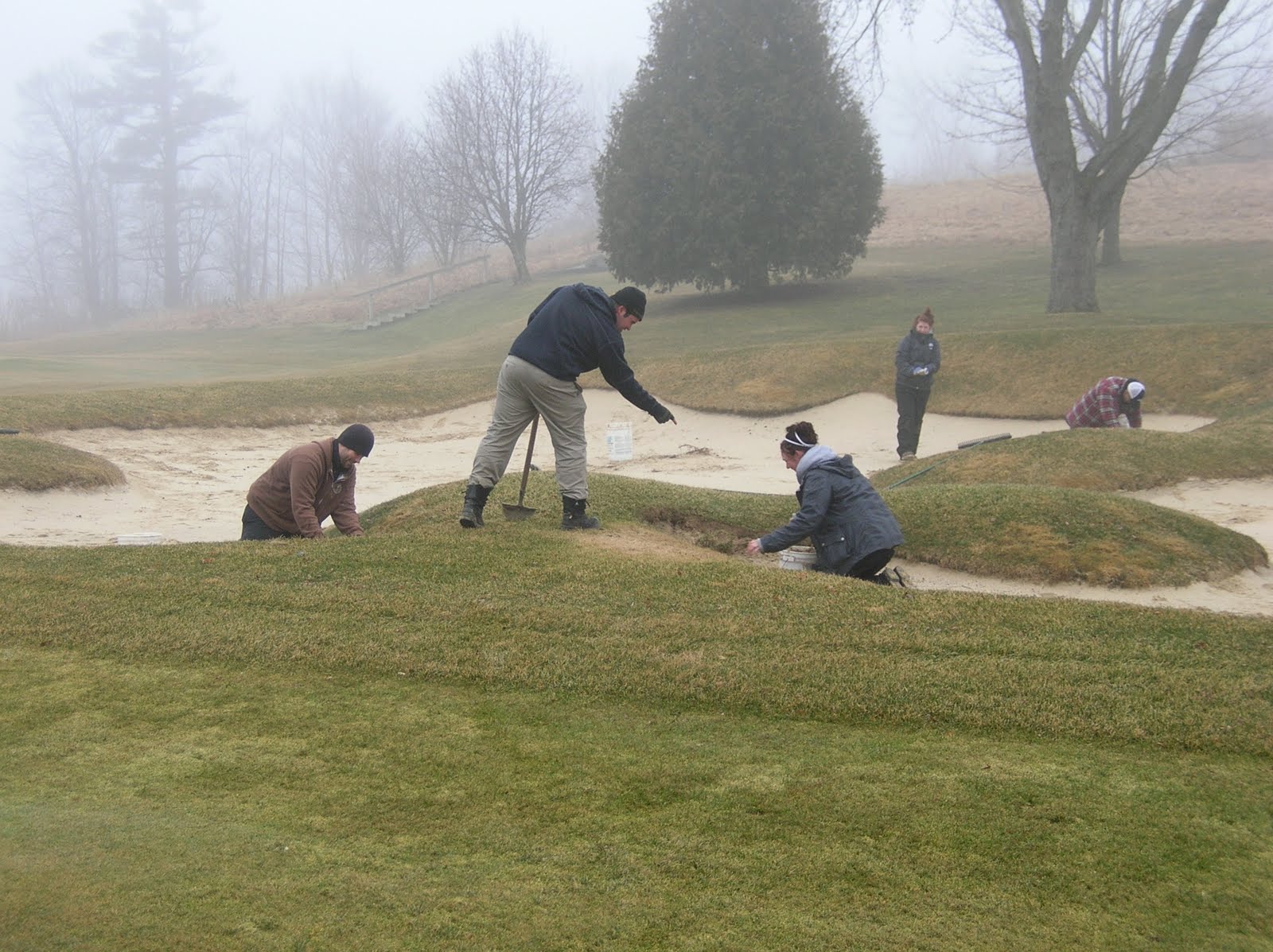
Another job we have been undertaking is repairs to some of the damaged bunker edges such a the one below.
This bunker edge at the 1st green is now six years old. Over this time sand ends up building up on top of the original topsoil changing the grade and causing a weak bunker edge as the turf is growing completely in a sand root zone which is no where as stable as soil. Something as simple as a golfer stepping on this edge can tear the roots and damage the edge as seen in this picture above.
Digging down with a shovel quickly shows that almost 7 inches of bunker sand has been deposited on top of the original soil. This meant that the repair job will take more time and effort than originally anticipated.
Step one is to use a sod cutter to cut away the turf above the area we need to repair. We used a soil probe ahead of this step to determine where the sand is deepest and how large an area we need to open up.
Next, this area is all dug out by hand. The material removed is contaminated and cannot be reused in the bunker. It is all hauled away to our dump.
We install a bunker board between the sand of the bunker and what will be soil and sod.
Then we add soil to level and shape the edge the way we want it and install sod. This picture above is waiting on soil to be added and shaped.


